




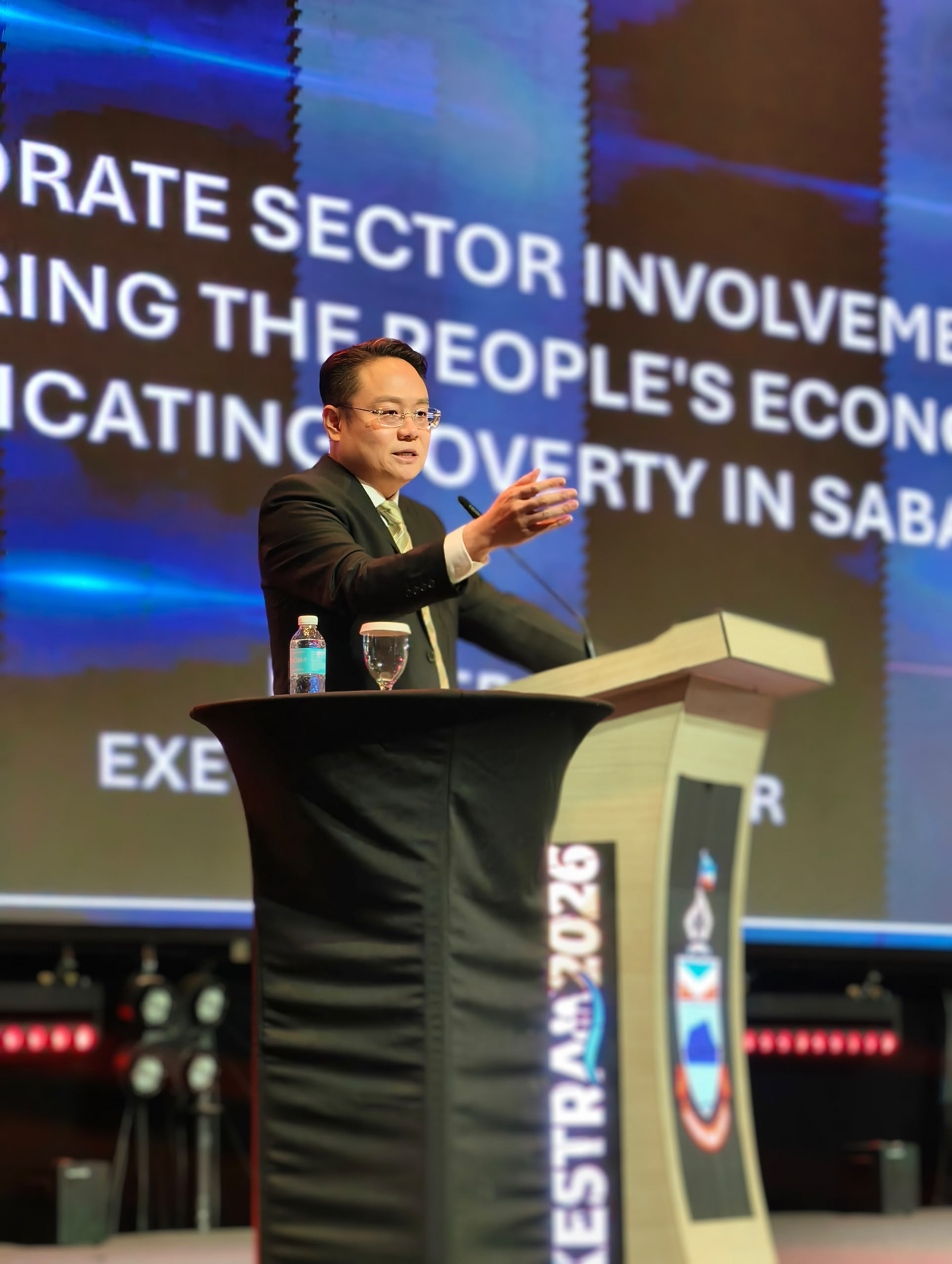
Datuk Dexter Lau delivering his presentation as a speaker at the 2026 Symposium on People’s Well-being and Transformation (KESTRA).
KOTA KINABALU: The corporate sector must play a more active role in supporting the government’s poverty eradication efforts by empowering communities, creating sustainable employment opportunities and ensuring beneficiaries do not slip back into poverty, said Kim Teck Cheong Group (KTC) executive director Datuk Dexter Lau.
He said while the government had made significant efforts to address poverty through financial assistance, education and skills training, the private sector must complement these initiatives by providing meaningful employment opportunities and long-term career development.
Speaking to reporters after participating in the People’s Wellbeing and Transformation Symposium at the Sabah International Convention Centre (SICC) here today, Lau said businesses must also reflect on their social responsibilities and contributions towards improving the livelihoods of underprivileged communities.
He said KTC’s approach was to help beneficiaries progress beyond the initial assistance provided by the government by equipping them with the skills, employment opportunities and support needed to become financially independent.
“If beneficiaries eventually return to square one, it will cost the government, taxpayers and businesses more resources. Therefore, the focus should be on helping people become self-sufficient and ensuring that they can sustain their livelihoods,” he said.
Lau said KTC was currently expanding its infrastructure and business operations, with the group targeting an annual turnover of between RM2 billion and RM3 billion within the next three to five years.
The expansion is also expected to increase its workforce from about 1,500 to 2,500 employees.
He stressed that business expansion must go hand in hand with efforts to develop employees’ capabilities, enhance their skills and provide opportunities for sustainable career growth.
On technological advancement, Lau revealed that KTC had begun integrating artificial intelligence (AI) across its operations from Oct 1, incorporating the group’s 90 years of corporate experience, three generations of business knowledge and decision-making processes into a systematic knowledge management framework.
Although the initiative had yet to be officially announced, he shared the development with government officials and stakeholders at the symposium to demonstrate how technology and knowledge management could enhance workforce competitiveness.
He said the initiative would also enable employees to improve their capabilities and provide equal opportunities for career advancement, regardless of their family background or personal circumstances.
“Ultimately, it is about asking the right questions, making personal efforts and having the willingness to perform. Independent thinking, self-development, proactiveness and hard work are essential,” he said.
Lau also highlighted KTC’s progress in increasing employment opportunities for the Bumiputera community, saying the group had successfully exceeded its initial target of raising Bumiputera representation in its workforce to 60 per cent.
He said that about five to six years ago, Bumiputera employees accounted for approximately 40 per cent of KTC’s workforce when the company was actively strengthening its corporate social responsibility (CSR) initiatives.
Today, the figure has increased to 70 per cent, surpassing the original target.
He attributed the achievement to the readiness and capabilities of employees, adding that providing the right opportunities and platforms would enable more people to contribute meaningfully to business growth.
Lau said sustainable poverty eradication required a collective commitment from the government, corporate sector and the people, in line with the Sabah Maju Jaya development agenda.
He said the government had continued to provide financial assistance, education and training to help disadvantaged communities improve their capabilities and gain access to employment opportunities.
However, he said the greater challenge was ensuring that beneficiaries could adapt to the working environment, maintain stable employment and avoid losing their jobs, which could potentially push them back into poverty.
He said KTC was committed to providing employment opportunities and continuous support to help employees establish themselves in the workforce and achieve long-term financial stability.
Lau stressed that closer collaboration between the government and corporate sector, coupled with sustainable opportunities for personal and professional development, was essential to achieving a win-win outcome and ensuring that all segments of society contributed towards eradicating poverty.
