




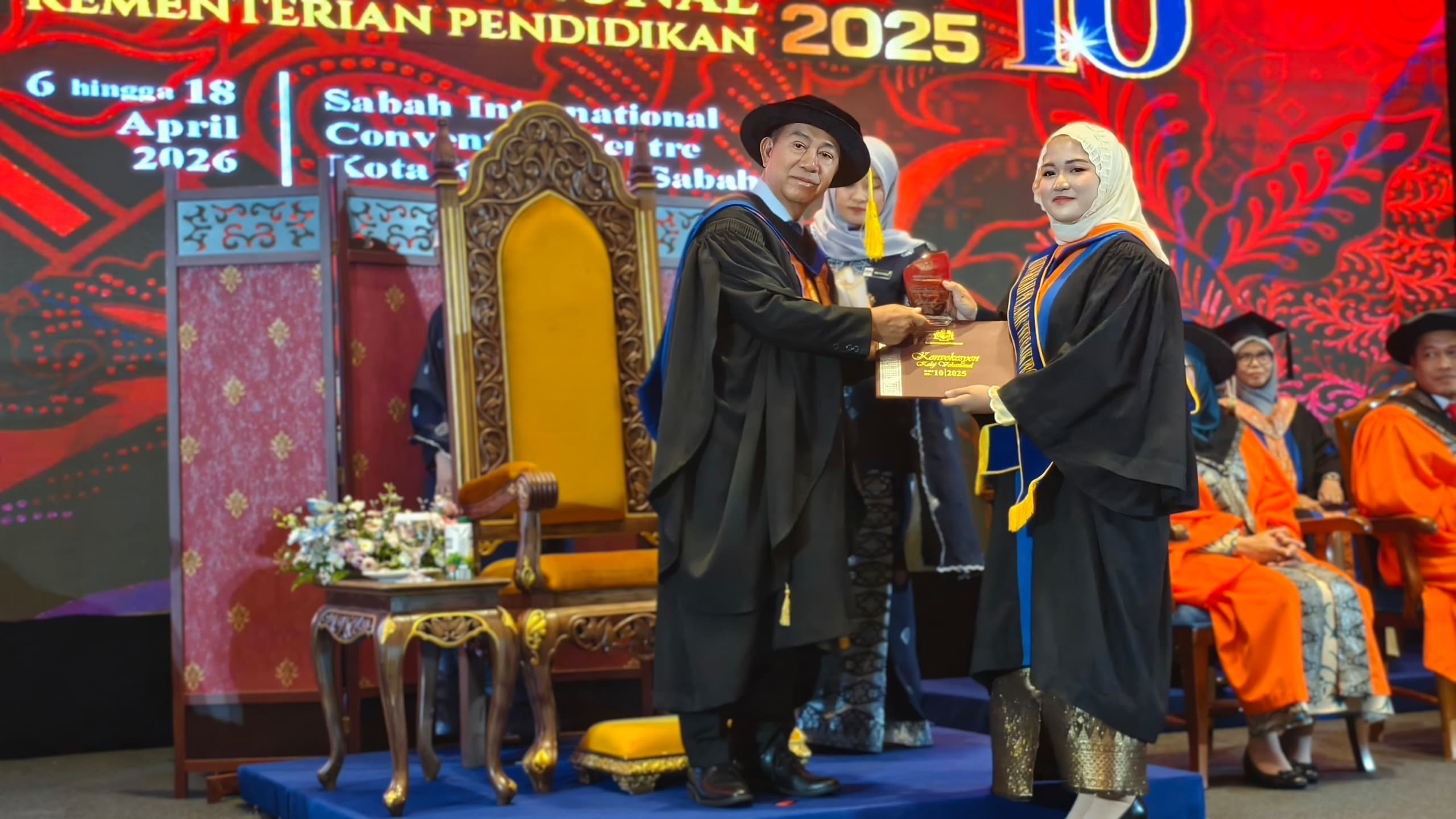
Siti Nur Hanisah Omar Hashim, from Keningau Vocational College (KV), is the recipient of the Best Academic Award for the Diploma in Early Childhood Education. She received a certificate, a plaque, and a cash prize worth RM1,000.
KOTA KINABALU: Chief Minister Datuk Seri Panglima Haji Hajiji Haji Noor said the State Government has allocated RM437.93 million this year to empower and develop human capital, not only from an academic perspective but also in terms of spiritual development.
He reiterated that the State Government will continue to prioritise the development of highly skilled human capital to boost Sabah’s economy.
“This is the best platform to steer Sabah’s economy towards high-value, knowledge and skills-oriented activities.
“This includes prioritising Technical and Vocational Education and Training (TVET) programmes, as well as Science, Technology, Engineering and Mathematics (STEM), innovation and digital technology,” he said at the Malaysian Education Ministry Vocational Colleges 10th Convocation ceremony at the Sabah International Convention
Centre (SICC) on Thursday.
His speech was delivered by Deputy Chief Minister I/Minister of Works and Utilities, Datuk Seri Panglima Dr Joachim Gunsalam.
A total of 1,000 graduates from Vocational Colleges in the Sabah Zone and the Federal Territory of Labuan received their diplomas at the convocation ceremony.
Hajiji congratulated the educators of vocational colleges, who have been the main drivers in advancing the nation’s TVET agenda.
“The commitment and hard work of educators play a significant role in advancing society and ensuring resilience in facing global challenges.
“This commitment aligns with the growing importance of TVET today, where it is no longer a second choice or alternative, but has become mainstream in the national education system and a primary pathway for our children to succeed and acquire skills that meet industry demands,” he said.
The Chief Minister said the increase in applications to vocational colleges from 28,098 in 2022 to 58,263 in 2026, compared to an intake capacity of 17,912 students, clearly reflects public confidence in skills-based education.
Based on The Future of Jobs Report 2025 by the World Economic Forum (WEF), the global job market is undergoing a major transformation, he added.
“By 2030, an estimated 170 million new jobs will be created, particularly in the fields of Artificial Intelligence (AI), renewable energy and the green economy.
“At the domestic level, the 13th Malaysia Plan (13MP) places strong emphasis on high growth, high-value (HGHV) sectors.
“This means the country requires a workforce that is not only technically skilled, but also digitally agile and sustainability-conscious,“ he said.
In line with these needs, the Ministry of Education Malaysia has developed a more dynamic and responsive TVET ecosystem through the Malaysia Education Blueprint (RPM) 2026–2035.
The Sabah Government, in this respect, is also doing so by prioritising the development of highly skilled human capital, he added.
