




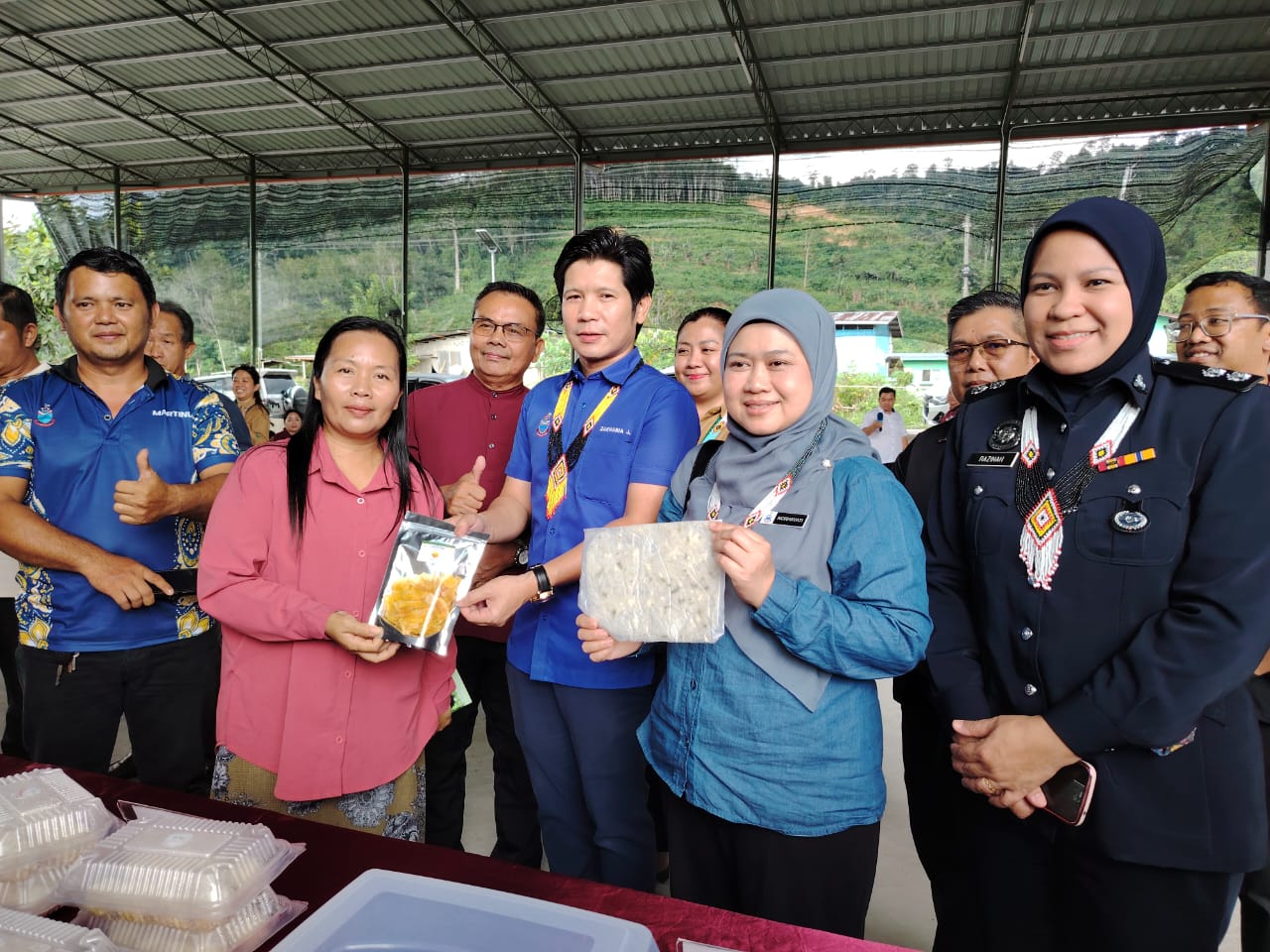
Holding up the chips they crafted from scratch, Zuliza (left) and Fauziah celebrate a milestone at the banana and tapioca chips-making workshop.
Preparing sugar-glazed banana chips may sound easy and straightforward to the uninitiated.
It is after all just a humble, rudimentary snack.
But if you think you simply need to fry a bunch of thinly sliced unripe bananas, dip them in sugary water, dry the water somehow and voila you have your sweet chips, you’re wrong. And, you are not alone.
Kindergarten Assistant, Fauziah Andugut, whose side hustle has been for a while in the making and selling of sweet banana chips, learned the hard way that this plain, humble snack is unassumingly difficult to make.
“I have tried many times and for so long, but I just couldn’t always get it right,” said Fauziah who finally learned the secret to the fine art of making perfect sweet banana chips at home.
She didn’t crack the code after countless failed attempts.
Fauziah was among the few lucky participants who learned the secret to perfect sweet banana chips during a workshop held in Kemabong last week.
“I started by learning from friends and have been working on refining my method but without the right technique it is difficult to get good quality chips.
“I used to dip fried banana chips in sugary water and then dry them in the pot but that doesn’t work.
“Instead of smooth, even glaze you will get uneven, clumpy sugar coating. The sugar also often turns black and the chips overcook,” she recounted her experience with an embarrassed giggle.
Now armed with the right knowledge, Fauziah is eager and ready to take this part-time income earner of hers to the next level.
Her job at the nursery requires her to only work half day and she is planning to fully utilize the other half to make extra money from sweet banana chips.
The income from this enterprise, if she can do it right, will significantly ease her household finance.
The banana chips industry represents a prominent segment in the broader snack market in Malaysia.
The industry, which is largely made up of localized micro-enterprises like Fauziah, deliver to the market roughly 113.8 tonnes of banana chips every month.
Although its national production value currently hovers only around RM9.3 million per annum, banana chips represent only a tiny fraction of the country’s 14.8 kg annual per capita banana consumption.
This means banana chips still have a huge potential for further growth.
Many micro-processors in Sabah, while operating under capacity, report that domestic market demand is very good and expect to expand their market in the future.
Roughly 97% of local banana chips are currently sold directly to domestic consumers, highlighting significant room for business expansion overseas.
And while standard fried banana chips dominate (around 91% of the Southeast Asian market share), niche variants like chocolate-coated chips are increasingly popular among younger consumers.
With the right marketing, better packaging and improved shelf-life, the sky is truly the limit for this familiar snack.
“I’m very grateful that I have been given the opportunity to join this course. We really learned a lot,” said the mother of seven.
Fauziah shared with enthusiasm some of her newly acquired knowledge.
In addition to recipes and cooking techniques, she also learned about various other important aspects of banana chips making.
This includes how to pick the best quality raw materials, packaging and branding.
“They walked us through various aspects and techniques in chips making.
Among other things, we learned how to pick the right raw materials, what the best banana or tapioca for making chips looks like and so on.
“We also learn about packaging and branding, how to make our products more attractive for the market.
“This is exactly what I need because I’m the type that uses the fire from a candle to seal the plastic wrapping of my chips. They don’t exactly look nice.
“But thanks to this course, I know now that there are ready-made air tight wrappings that I can just buy out there. And they can keep the chips crispy for up to three months,” she sheepishly smiled.
The Flavoured Banana and Tapioca Chips Processing Course was organized by Kemabong Sub-district Office, in collaboration with Sabah Rural Development Ministry and Tenom Agriculture Office.
Another participant, full time housewife Zuliza Zulfikar from Kampung Seri Menanti, said she made it a point to attend the course despite having to manage the caring for her children while she was away.
She said the knowledge she gained from the course will be useful to complement the cake making business she currently operates from home.
“I’m looking forward to applying the new knowledge I have learned today to generate more income without having to leave my children at home,” she said.
Kemabong Assistant Sub-District Officer Zakharia Jamal when officiating the programme said socio-economic empowerment and human capital development were among the agendas identified for moving the district forward.
He said these agendas were in line with the aspirations of the local elected representatives who wanted to see more high-impact skill training carried out for their constituents.
Zakharia also expressed hope that the government can set up a chips processing facility to help local chips makers in the district.
“Such a facility dedicated to helping locals produce their chips will greatly help improve the economy of our community,” he said.
Meanwhile, one of the trainers for the course, Suzilah Johnary from the Food and Agro-Based Industry Unit of Tenom Agriculture Office, informed that banana and tapioca were chosen to be developed into downstream products as they are abundantly available in Kemabong.
She noted her unit was tasked with training and guiding locals to produce quality downstream products.
“The course participants were given theoretical and practical tutorials covering standard operating procedures in clothing, food quality and cleanliness, quality control, packaging and labeling.
“This knowledge is a foundation that can be easily adapted into their production process. It will enable them to produce and sell their products better,” she said.
The two-day course held at Kampung Gumisi Ulu Community Hall benefited 20 participants from various backgrounds, mainly B40 listed in the National Poverty Data Base System (eKasih)./Penerangan–
