




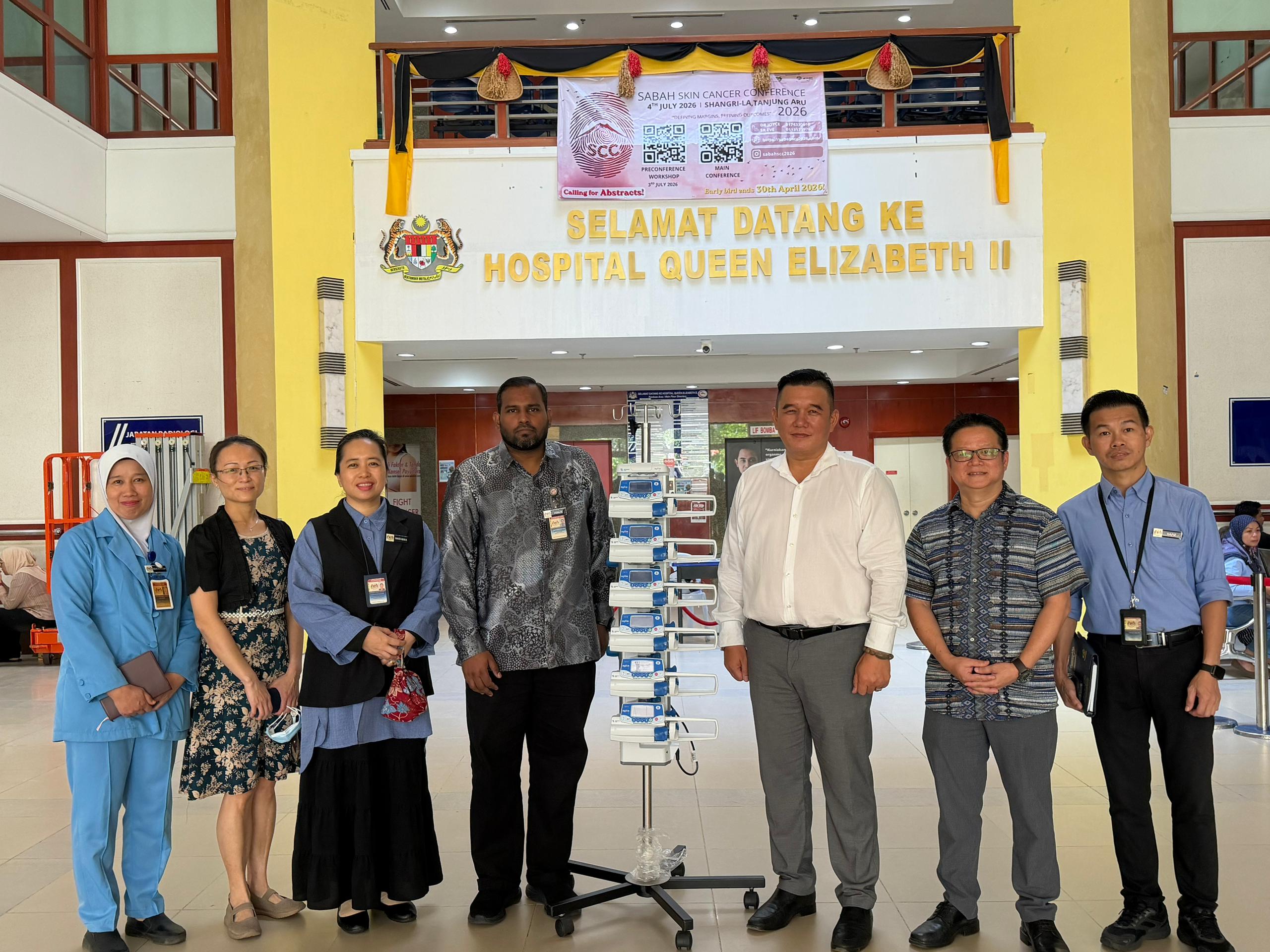
Petrus C. Mojuntin (third from right) during the official handover of medical equipment to Hospital Queen Elizabeth II, Kota Kinabalu.
Bro St John ambulance (Malaysia) Pbsa..
KOTA KINABALU: St. John Ambulance Malaysia (PBSA) today handed over medical equipment worth RM38,000 to Hospital Queen Elizabeth II (QEH II) as part of its corporate social responsibility (CSR) initiative aimed at strengthening critical healthcare services in Sabah.
The equipment, comprising a specialised Fluid Management System, a Fresenius Kabi Agilia Link 6 infusion system and six syringe pumps, was officially presented by St. John Ambulance Malaysia (PBSA),Superintendent (Operations), Petrus C. Mojuntin, during a handover ceremony held at the hospital lobby.
The contribution was received by QEH II Deputy Director Dr Parvin Rubon Arangulavan, witnessed by members of the hospital’s management team.
The syringe pumps will be deployed at the hospital’s Cardiac Intensive Care Unit (CICU), where they will enable the precise and continuous administration of high-risk cardiovascular and respiratory medications for critically ill patients.
Speaking at the ceremony, Petrus said the initiative reflects SJAM’s ongoing commitment to supporting the public healthcare system through strategic collaboration with government agencies, healthcare institutions and the private sector.
He said the organisation remains dedicated to complementing emergency medical services through first aid education, cardiopulmonary resuscitation (CPR) and automated external defibrillator (AED) awareness programmes, blood donation campaigns, youth leadership development and humanitarian initiatives.
Petrus, however, noted that while the Ministry of Health continues to provide qualified medical personnel and essential equipment, procurement processes are often delayed by administrative procedures.
He said government hospitals, regional health departments and rural health clinics in Sabah urgently require more specialised medical equipment, adding that unnecessary bureaucratic delays could directly affect patient care.
Petrus also commended the Sabah Government’s RM8.5 million Sabah Maju Jaya (SMJ) Health Assistance Scheme initiative implemented in 2025, which saw 100 haemodialysis machines distributed to 23 hospitals and two health clinics across the state to ease the burden on patients with End-Stage Renal Failure (ESRF).
He described the initiative as a model for improving healthcare delivery, citing benefits including treatment fee exemptions at participating government facilities and monthly financial assistance for eligible patients undergoing Continuous Ambulatory Peritoneal Dialysis (CAPD) at home.
To further strengthen Sabah’s healthcare system, Petrus proposed that greater opportunities be given to Sabah-based suppliers to provide medical equipment directly to government healthcare facilities.
He said engaging local suppliers would help accelerate procurement, improve maintenance response times and generate greater economic benefits within the state.
Petrus also called on the relevant authorities to streamline procurement procedures and optimise supply chain management to ensure hospitals receive essential medical equipment without unnecessary delays, ultimately improving healthcare services for the people of Sabah.
