




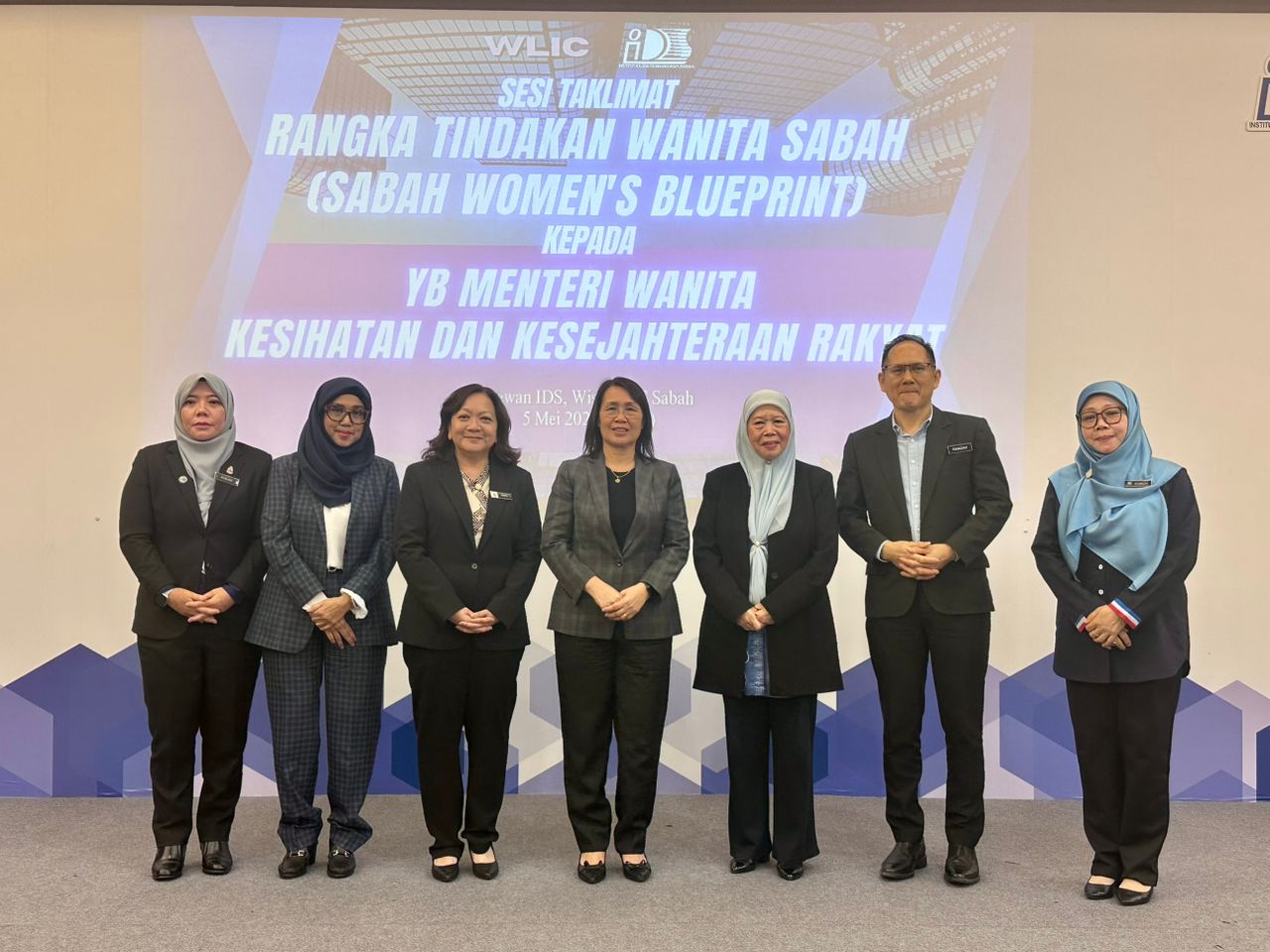
KOTA KINABALU: The Sabah Institute for Development Studies (IDS) presented the Sabah Women’s Action Plan, a comprehensive blueprint aimed at strengthening women’s participation in leadership and decision-making across the state.
Sabah Minister of Women, Health and People’s Wellbeing, Datuk Julita Majungki said the document is designed for implementation, with a focus on better coordination among stakeholders.
“In my view, this is a very comprehensive document. What we need now is coordination so we can function as one team to achieve what has been outlined,” she said during the briefing at Wisma IDS here Tuesday.
Data presented, largely based on 2023 figures, showed mixed progress.
While women’s leadership in the public sector has achieved the 30 per cent target, representation remains low in other areas — including 17 per cent in state Government-Linked Companies (GLC) boards and 24 per cent in statutory bodies.
Political representation also remains limited, with women making up 12 per cent of Members of Parliament and 8.86 per cent in the State Legislative Assembly (2023).
At the grassroots level, figures from 2022 to 2024 show only 17.01 per cent of Village Development and Security Committee (JKKK) chairpersons are women, while women make up 18 per cent of local council members and just 4 per cent of executive heads in local authorities (2023–2025).
Despite this, women’s economic participation remains strong, with 69.3 per cent involved in entrepreneurship and 59 per cent in social enterprises, although overall female labour force participation stood at 55.9 per cent compared to 70.1 per cent for men (2023).
Julita said many initiatives are already in place, but alignment remains key.
“Many of these efforts already exist. The key now is proper coordination and alignment so they can be implemented in a more focused and organised manner,” she said.
She added that implementation must take into account local realities, including cultural factors, particularly at the grassroots level.
“We must ensure our approach is inclusive and workable within our communities,” she said.
